
Micro vs Nano Hydroxyapatite: What's the Difference in Toothpaste?
If you have shopped for a fluoride-free toothpaste lately, you have probably seen "nano-hydroxyapatite" and "micro-hydroxyapatite" on labels and wondered whether the difference matters. Short answer: they are the same mineral, made in different particle sizes. Each has research behind it, and each has trade-offs. Here is a plain-English guide to both, plus why Huppy chose the micro form.
What is hydroxyapatite?
Hydroxyapatite (often shortened to HAp or HAP) is a calcium phosphate mineral. It is the main mineral in tooth enamel and bone, which is why toothpaste makers describe it as "biomimetic," meaning it mimics a material your body already makes. In toothpaste, synthetic hydroxyapatite is used as a fluoride-free active ingredient and as a gentle polishing agent.
Micro vs nano hydroxyapatite: the difference is particle size
Chemically, nano and micro hydroxyapatite are identical. The difference is how big the particles are:
- Nano-hydroxyapatite is made of particles under 100 nanometers in at least one dimension. Much of the early laboratory research and many tooth-sensitivity studies used nano-sized particles.
- Micro-hydroxyapatite (sometimes called microcrystalline hydroxyapatite) is made of larger particles, often clusters of tiny crystals. Several of the best-known clinical caries trials of fluoride-free hydroxyapatite toothpaste used the microcrystalline form.
Neither form is "the real one." Particle size changes things like texture, how the ingredient behaves in a formula, and how regulators review it.
What the research says
Clinical trials of microcrystalline hydroxyapatite
Two randomized controlled trials are often cited for the micro form:
- A 1-year trial in 207 young children compared a fluoride-free microcrystalline hydroxyapatite toothpaste with a fluoride toothpaste. Caries progression was similar in both groups (72.7% vs 74.2% of children showed an increase), and the hydroxyapatite toothpaste met the trial's test for being not inferior to fluoride (Paszynska et al., Scientific Reports, 2021).
- A 6-month trial in 147 orthodontic patients at high risk of cavities compared a fluoride-free microcrystalline hydroxyapatite toothpaste with a 1,400 ppm fluoride toothpaste. The researchers found no significant difference in early enamel caries between the groups (Schlagenhauf et al., Journal of Investigative and Clinical Dentistry, 2019).
Reviews of hydroxyapatite toothpaste in general
Systematic reviews that pool trials of both particle sizes have concluded that hydroxyapatite toothpaste performs well against placebo and comparably to fluoride in the studies available (Limeback et al., Canadian Journal of Dental Hygiene, 2021; Pawinska et al., Journal of Dentistry, 2024). To be fair to readers: two authors of those reviews are employed by a company that makes hydroxyapatite toothpaste, which the papers disclose, and the total number of clinical trials is still modest. An independent commentary on the 2024 review agreed hydroxyapatite toothpaste can be considered a good alternative to fluoride (Gugnani & Gugnani, Evidence-Based Dentistry, 2025).
Safety reviews of nano-hydroxyapatite
Because nanoparticles get extra regulatory scrutiny, the European Commission's Scientific Committee on Consumer Safety (SCCS) has reviewed nano-hydroxyapatite more than once. In 2018 it said needle-shaped nano particles were a concern and should not be used in cosmetic products, and that the data were not yet enough to judge other shapes (SCCS, Regulatory Toxicology and Pharmacology, 2018). In its 2023 opinion it concluded nano-hydroxyapatite is safe at up to 10% in toothpaste and 0.465% in mouthwash, but only for uncoated, rod-shaped particles that meet specific size criteria. That opinion does not cover needle-shaped particles or sprays (SCCS/1648/22, 2023).
So nano-hydroxyapatite is not "unsafe." It is a well-studied ingredient with conditions attached, and it matters which particles a brand actually uses.
Micro vs nano at a glance
| Micro-hydroxyapatite | Nano-hydroxyapatite | |
|---|---|---|
| Mineral | Hydroxyapatite | Hydroxyapatite |
| Particle size | Larger particles or crystal clusters | Under 100 nm in at least one dimension |
| Fluoride-free caries trials | Yes, including RCTs in children and orthodontic patients | Yes, plus many tooth-sensitivity studies |
| Extra nanomaterial review in the EU | No | Yes. Considered safe only for specified rod-shaped particles |
Why Huppy uses 10% micro-hydroxyapatite
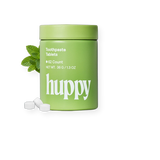
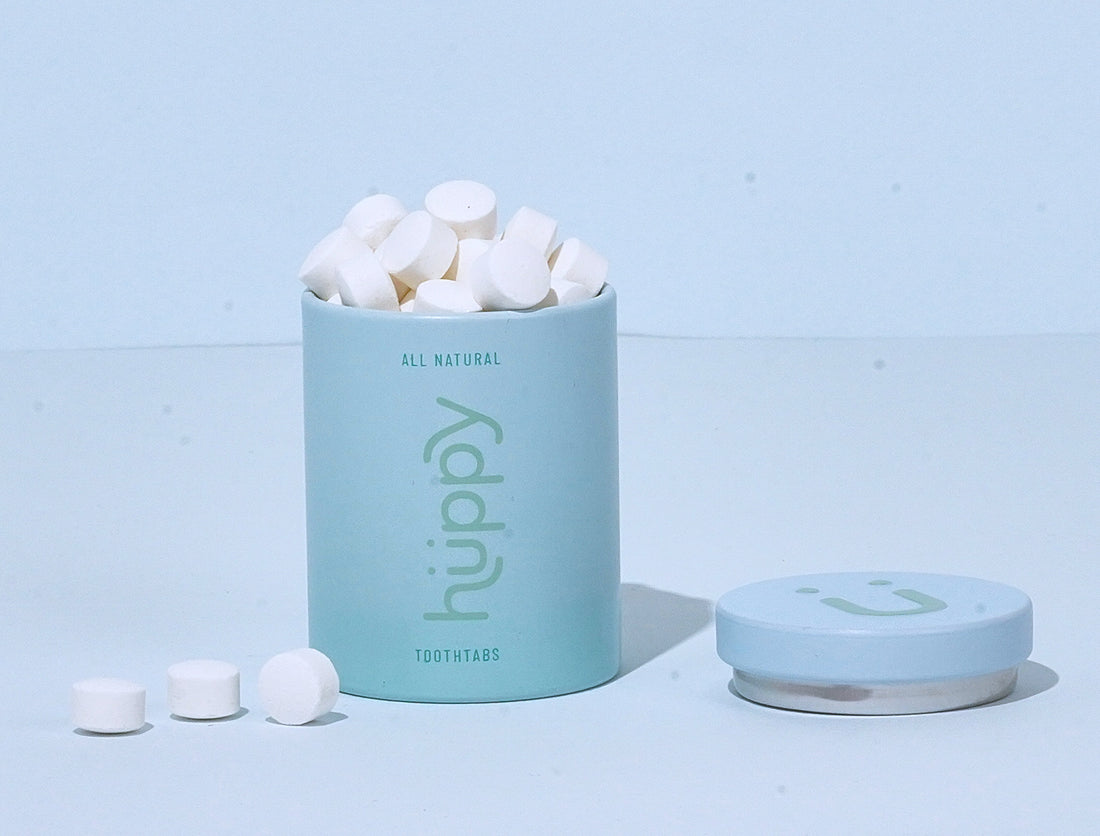
Every Huppy toothpaste tablet contains 10% micro-hydroxyapatite. We chose the micro form on purpose, not nano. It lets us use a meaningful amount of hydroxyapatite with a particle size that sits outside the nanomaterial question entirely, and it is the form used in the microcrystalline clinical trials above. Pair that with no fluoride, no SLS, Clean Ingredients, plastic-free packaging, and a tablet that is TSA-Ready for carry-ons, and you have the toothpaste we wanted for ourselves.
If you are comparing brands, many good toothpaste tablets now use hydroxyapatite in one form or another. Our honest comparison of the best toothpaste tablets lays out how Huppy stacks up against Bite, NOBS, Unpaste and others. If you have sensitive teeth, read our guide to hydroxyapatite toothpaste for sensitive teeth.
Try Huppy Toothpaste Tablets → or browse all toothpaste tablet flavors.
Frequently asked questions
Is micro-hydroxyapatite as good as nano-hydroxyapatite?
They are the same mineral, and both have clinical research behind them. The best-known fluoride-free caries trials in children and orthodontic patients used microcrystalline hydroxyapatite. Nano-hydroxyapatite has a large body of research too, especially for sensitivity. There is no strong head-to-head clinical evidence that one size beats the other in toothpaste.
Is nano-hydroxyapatite safe?
The EU's Scientific Committee on Consumer Safety concluded in 2023 that nano-hydroxyapatite is safe in toothpaste at up to 10%, but only for uncoated, rod-shaped particles meeting set criteria. Needle-shaped particles are not covered. If you prefer to avoid nanomaterials altogether, choose a toothpaste with micro-hydroxyapatite.
Does Huppy use nano-hydroxyapatite?
No. Huppy toothpaste tablets use 10% micro-hydroxyapatite, a deliberate choice over nano.
Can hydroxyapatite replace fluoride?
Clinical trials have found fluoride-free hydroxyapatite toothpaste performed comparably to fluoride toothpaste for early caries in the groups studied. Your dentist knows your cavity risk best, so ask them which toothpaste fits you.
Sources
- Paszynska E, et al. Impact of a toothpaste with microcrystalline hydroxyapatite on the occurrence of early childhood caries: a 1-year randomized clinical trial. Scientific Reports. 2021;11:2650. PubMed 33514787
- Schlagenhauf U, et al. Impact of a non-fluoridated microcrystalline hydroxyapatite dentifrice on enamel caries progression in highly caries-susceptible orthodontic patients: a randomized, controlled 6-month trial. Journal of Investigative and Clinical Dentistry. 2019;10(2):e12399. PubMed 30701704
- Limeback H, Enax J, Meyer F. Biomimetic hydroxyapatite and caries prevention: a systematic review and meta-analysis. Canadian Journal of Dental Hygiene. 2021;55(3):148-159. PubMed 34925515
- Pawinska M, et al. Clinical evidence of caries prevention by hydroxyapatite: an updated systematic review and meta-analysis. Journal of Dentistry. 2024;151:105429. PubMed 39471896
- Gugnani N, Gugnani S. Do we have enough evidence to recommend hydroxyapatite toothpaste for preventing dental caries? Evidence-Based Dentistry. 2025;26(1):38-39. PubMed 39984606
- Scientific Committee on Consumer Safety. Revision of the opinion on hydroxyapatite (nano) in cosmetic products. Regulatory Toxicology and Pharmacology. 2018;98:274-275. PubMed 30125613
- Scientific Committee on Consumer Safety. Opinion on hydroxyapatite (nano), SCCS/1648/22, adopted March 2023. European Commission